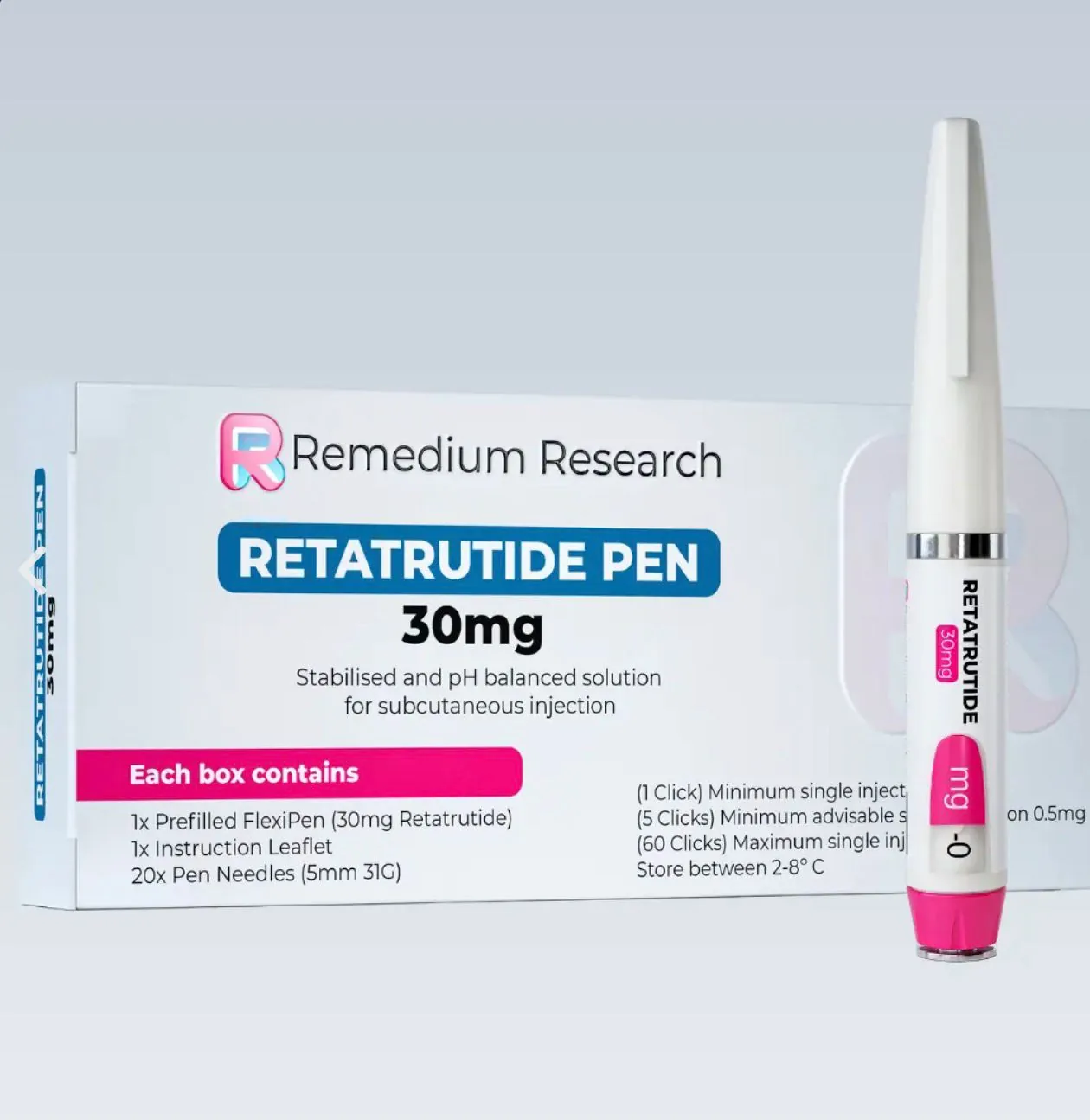
Buy retatrutide premixed pen (30 mg)
Original price was: $250.00.$210.00Current price is: $210.00.
Buy Retatrutide Premixed Pen (30 mg) Online
Retatrutide premixed pen represents the next generation of metabolic therapeutics, acting as a highly potent GIP, GLP-1, and Glucagon (GCG) receptor tri-agonist. Often referred to in clinical development as “Triple-G,” this peptide therapy expands upon the mechanisms of dual-agonists (like tirzepatide) to drive profound weight reduction, glycemic control, and lipid management.
The 30 mg premixed pen is a multi-dose configuration designed for precise subcutaneous delivery, offering a streamlined approach to a multi-week maintenance regimen.
1. Mechanism of Action: The Tri-Agonist Advantage
Retatrutide’s unprecedented efficacy stems from its multi-pathway targeting, which addresses metabolic dysfunction via three distinct physiological vectors:
-
GIP Receptor Agonism (Glucose-Dependent Insulinotropic Polypeptide): Enhances postprandial insulin secretion, suppresses glucagon release during hyperglycemia, and optimizes adipose tissue lipid buffering to minimize systemic fat deposition.
-
GLP-1 Receptor Agonism (Glucagon-Like Peptide-1): Delays gastric emptying to increase satiety, slows digestion, and signals the central nervous system (specifically the hypothalamus) to reduce hedonic and homeostatic appetite.
-
Glucagon Receptor Agonism: Stimulates hepatic energy expenditure, increases thermogenesis, and directly accelerates fatty acid oxidation in the liver—combating non-alcoholic fatty liver disease (NAFLD/MASH) while amplifying overall caloric burn.
2. Hardware Architecture & Dose Management
The 30 mg premixed pen is engineered to eliminate manual reconstitution, reducing contamination risks and volumetric calculations for the user.
Device Specifications
-
Total Peptide Mass: 30 mg of sterile Retatrutide in solution.
-
Delivery Mechanism: Dial-a-dose, multi-use mechanical injector pen.
-
Administration Vector: Subcutaneous injection (optimized for the abdomen, thigh, or upper arm).
-
Required Accessories: Sterile, disposable 31G or 32G pen needles (single-use only).
Multi-Week Maintenance Budget
Because retatrutide therapy strictly requires a conservative, progressive escalation to mitigate gastrointestinal side effects, a 30 mg pen is typically budgeted across a multi-week block during maintenance phases.
Clinical Mandate: Treatment must always begin at a low introductory titration (typically 2.0 mg to 4.0 mg weekly). The 30 mg pen should only be deployed once a stable, higher-tier maintenance dosage has been clinically established.
3. Storage, Stability, and Handling Protocols
Peptide compounds are highly susceptible to thermal degradation and structural shearing. Adherence to strict cold-chain management is require to maintain molecular integrity.
-
Primary Cold-Chain Storage: Unuse, pristine pens must be store continuously in refrigeration between 2°C and 8°C (36°F to 46°F). Do not freeze.
-
In-Use Room Temperature Window: Once a pen is pierce or brought to room temperature, it can typically be held at up to 25°C (77°F) for a maximum of 21 to 28 days. It must be kept away from direct sunlight and radiant heat sources.
-
Aseptic Handling: The rubber septum must be sanitize with a 70% isopropyl alcohol swab prior to attaching a fresh needle. The needle must be remove immediately post-injection to prevent atmospheric air from entering the reservoir.
4. Clinical Efficacy Profile
Data from Phase II and Phase III clinical trials demonstrate that retatrutide yields unmatched metabolic metrics compared to older mono- and dual-agonist therapies:
-
Unprecedented Weight Reduction: Clinical models demonstrate an average body weight reduction approaching 24% over 48 weeks at optimized maintenance doses, setting a new benchmark for non-surgical weight management.
-
Hepatic Fat Clearance: Due to the added glucagon component, users exhibit up to an 80% reduction in liver fat content, making it a primary candidate for treating metabolic dysfunction-associated steatohepatitis.
-
Glycemic Control: Provides robust, glucose-dependent reduction in HbA1c levels, driving high rates of type 2 diabetes management and restoration of insulin sensitivity.
5. Side Effect Profiling & Risk Mitigation
The powerful therapeutic profile of triple-receptor agonism introduces specific physiological responses that require careful clinical monitoring.
| Physiological System | Potential Manifestation | Mitigation Strategy |
| Gastrointestinal | Nausea, vomiting, delayed gastric emptying, diarrhea | Maintain strict, gradual titration schedules; optimize hydration and prioritize lean protein intake. |
| Cardiovascular | Transient elevation in resting heart rate (typical of glucagon/GIP activation) | Routine monitoring of resting pulse; slower titration for individuals with pre-existing cardiovascular conditions. |
| Hydration/Electrolyte | Increased renal excretion, decreased thirst drive | Conscious, scheduled consumption of water and balanced electrolytes to offset reduced oral intake. |
Contraindications: Retatrutide is strictly contraindicated in individuals with a personal or family history of Medullary Thyroid Carcinoma (MTC) or Multiple Endocrine Neoplasia syndrome type 2 (MEN 2). Use must be discontinued immediately if acute pancreatitis is suspected.
Frequently Asked Questions (FAQ)
Mechanism & Clinical Application
How does Retatrutide differ from Semaglutide and Tirzepatide?
Retatrutide is a tri-agonist, meaning it targets three distinct metabolic pathways: GIP, GLP-1, and Glucagon (GCG) receptors. In contrast, Semaglutide is a single GLP-1 receptor agonist, and Tirzepatide is a dual GIP/GLP-1 receptor agonist. The addition of the Glucagon receptor in Retatrutide uniquely accelerates hepatic fatty acid oxidation and increases metabolic energy expenditure.
Why does a 30 mg pen require a titration schedule?
Because tri-agonists profoundly alter gastrointestinal motility and metabolic signaling, introducing a high maintenance dose immediately would induce severe nausea, vomiting, or acute gastroparesis. A clinical titration schedule allows the body’s enteric nervous system to gradually adapt to the hormonal changes.
Pen Operation & Dosing
How do I accurately dial a specific dose on a 30 mg multi-dose pen?
Multi-dose dial-a-dose pens rely on mechanical “clicks” or visible mg/mL indicators on a rotating dial. Because the 30 mg total mass is dissolved in a specific volume of liquid (e.g., 3 ml), you must consult the manufacturer’s specific increment chart. For example, if the pen is calibrated so that 0.5 mL equals 5 mg, you rotate the dial until the window displays the exact designated metric before deploying the needle.
What should I do if air bubbles are visible inside the solution reservoir?
Micro-bubbles are common and do not pose a safety risk for subcutaneous injections. However, a large air gap can cause under-dosing. Before your first injection with a new pen, perform a prime sequence: dial the minimum setting (typically 1 click), point the needle upward, and depress the injection button until a drop of liquid appears at the needle tip.
Storage, Handling, & Troubleshooting
Can I reuse the needle if I am the only person using the pen?
No. Pen needles are strictly single-use and disposable. Reusing a needle dulls the tip (causing painful injections and tissue bruising), strips the sterile silicone coating, and introduces microscopic bacteria from the skin back into the sterile 30 mg solution reservoir, risking contamination of the remaining peptide.
What happens if the premixed pen accidentally freezes?
If the solution has frozen solid or shows signs of cloudiness, precipitation, or structural separation after thawing, the peptide has suffered irreversible structural shearing. Freezing breaks down the delicate amino acid chains of Retatrutide, rendering it biologically inactive. Do not use a frozen pen; it must be discard safely.
How do I dispose of the pen once the 30 mg of solution is completely exhausted?
The outer casing of the pen can be treated as standard waste, but any attach needles or components that have come into contact with biological fluids must be place immediately into an FDA-clear Sharps disposal container or a puncture-resistant, heavy-duty plastic household container (such as a laundry detergent bottle with a secure lid) to prevent accidental needle-stick injuries.
Therapeutic Portfolio Comparison: Next-Generation Peptide Systems
To understand where Retatrutide fits within contemporary metabolic medicine, it must be compared to the primary mono- and dual-agonist therapies that preceded it. The table and sections below contrast Retatrutide (Triple Agonist) against Tirzepatide (Dual Agonist) and Semaglutide (Mono Agonist).
Technical and Pharmacological Breakdown
| Metric / Feature | Semaglutide (Mono) | Tirzepatide (Dual) | Retatrutide (Triple) |
| Receptor Targets | GLP-1 | GIP / GLP-1 | GIP / GLP-1 / Glucagon (GCG) |
| Primary Clinical Indication | T2D Management & Obesity | T2D Management & Obesity | Advanced Weight Management / MASH (Phase III)* |
| Average Weight Loss (Peak) | ~15% body weight | ~21% body weight | ~24%+ body weight |
| Energy Expenditure Impact | Indirect (Satiety-driven) | Indirect (Improved metabolic efficiency) | Direct (Glucagon-driven hepatic thermogenesis) |
| Hepatic Fat Reduction | Moderate reduction | High reduction | Profound reduction (up to 80%+ clearance) |
| Typical Weekly Dose Range | 0.25 mg to 2.4 mg | 2.5 mg to 15.0 mg | 2.0 mg to 12.0 mg |
*Note: Retatrutide is navigating late-stage Phase III clinical trials as of 2026 to secure official global regulatory approvals for widespread clinical prescription.
Key Differentiators Explained
1. Receptor Targeting Dynamics
-
Semaglutide: Acts exclusively on the GLP-1 receptor to slow gastric emptying and suppress appetite via central nervous system signaling. Shop Now
-
Tirzepatide: Combines GLP-1 agonism with GIP activation. The GIP component acts synergistically to improve lipid buffering in adipose tissue and drastically reduces the severity of gastrointestinal side effects typically caused by pure GLP-1 stimulation.
-
Retatrutide: Introduces a third vector—the Glucagon (GCG) receptor. While glucagon naturally increases blood glucose in fasting states, when balanced precisely alongside GIP and GLP-1 agonism, it safely stimulates the liver to burn fat, increases resting energy expenditure, and directly accelerates caloric burning.
2. Efficacy Benchmarks (Weight Loss & Metabolic Outcomes)
-
Semaglutide: Established a highly reliable baseline in clinical history, demonstrating an average of 15% reduction in total body weight over a 68-week timeline.
-
Tirzepatide: Advanced past mono-therapy, achieving average body weight reductions of up to 21% over 72 weeks by leveraging dual-receptor synergy.
-
Retatrutide: Outperforms both historical benchmarks in clinical data, demonstrating an average weight loss of approximately 24% in a compressed 48-week timeline.
3. Impact on Steatotic Liver Disease (NAFLD / MASH)
-
Semaglutide & Tirzepatide: Reduce liver fat accumulation primarily as a secondary benefit resulting from overall systemic weight loss and improved systemic insulin sensitivity.
-
Retatrutide: Targets the liver directly. The glucagon receptor component triggers immediate intrahepatic fatty acid oxidation. Clinical trials show that over 80% of participants with baseline fatty liver disease achieve complete normalization of hepatic fat content during therapeutic maintenance, making it a highly targeted treatment for metabolic dysfunction-associated steatohepatitis.
4. Side Effect Profiles and Tolerability
-
Semaglutide: Most side effects are gastrointestinal (nausea, constipation, acid reflux) due to its singular, heavy reliance on delaying gastric emptying.
-
Tirzepatide: Generally exhibits a more favorable tolerability profile than high-dose mono-agonists because the GIP pathway mitigates a portion of the gastrointestinal distress while amplifying weight loss.
-
Retatrutide: Introduces unique cardiovascular considerations alongside typical gastrointestinal adaptations. Due to glucagon and GIP activity, individuals experience a transient, predictable increase in resting heart rate during the escalation phase, requiring closer cardiac monitoring during early titration compared to semaglutide or tirzepatide.
Related products
-
Buy Yohimbine A 10ml Online | Premium Yohimbine HCl Liquid Formula
Price range: $210.00 through $1,250.00Select options This product has multiple variants. The options may be chosen on the product pageYohimbine A 10ml Liquid is a fast-acting Yohimbine HCl formula designed to support energy, performance, metabolic activity, and workout-focused supplementation. Its liquid delivery format allows convenient administration and flexible dosing for experienced users.
-
Zycortal
$80.00Add to cartZycortal is a veterinary medication specifically designed to manage Addison’s disease in dogs, a condition medically termed hypoadrenocorticism. This disease occurs when the adrenal glands fail to produce sufficient hormones to regulate essential bodily functions. As a form of hormone replacement therapy, Zycortal helps restore hormonal balance in affected dogs, alleviating symptoms and improving their quality of life.
-
Follistatin 344 1mg For Sale Near Me
$210.00Add to cartFollistatin 344 (1mg): A Comprehensive Overview Follistatin 344 is a well-researched and highly sought-after peptide for its ability to promote muscle growth by inhibiting myostatin. A protein that limits muscle tissue development. Bodybuilders, athletes, and researchers are drawn to Follistatin 344. For its potential to significantly enhance muscle mass without the need for anabolic steroids. …

Top rated products
-
 Buy HYGETROPIN 100iu
$130.00
Buy HYGETROPIN 100iu
$130.00
-
 Buy Ascorbate 100mg
$60.00
Buy Ascorbate 100mg
$60.00
-
 Biosal injection
$40.00
Biosal injection
$40.00
-
 Boldenone For Horses
$45.00
Boldenone For Horses
$45.00
-
 tussionex cough syrup
$230.00
tussionex cough syrup
$230.00
On Sale
-
 Federgold Calcium-Fit 500ml
Original price was: $25.00.$20.00Current price is: $20.00.
Federgold Calcium-Fit 500ml
Original price was: $25.00.$20.00Current price is: $20.00.
-
 De Patagoon Soft Acid IV+ For Sale Online
Original price was: $50.00.$40.00Current price is: $40.00.
De Patagoon Soft Acid IV+ For Sale Online
Original price was: $50.00.$40.00Current price is: $40.00.
-
 Buy ropadiar solution 20%
Original price was: $120.00.$100.00Current price is: $100.00.
Buy ropadiar solution 20%
Original price was: $120.00.$100.00Current price is: $100.00.
-
 Cystorelin for cows
Original price was: $60.00.$50.00Current price is: $50.00.
Cystorelin for cows
Original price was: $60.00.$50.00Current price is: $50.00.
-
 Catosal for horses
Original price was: $60.00.$50.00Current price is: $50.00.
Catosal for horses
Original price was: $60.00.$50.00Current price is: $50.00.